
What happens when a health insurance company makes you sick? This is my firsthand account of how Elevance (formerly Anthem) failed to meet its legal and ethical obligations, ultimately forcing my constructive discharge in 2022. I am providing this formal account to document the systemic failure of my former employer, Elevance (formerly Anthem), to meet its legal and ethical obligations toward me, culminating in my constructive discharge in 2022.
The following timeline details a clear cause-and-effect relationship between the employer’s conduct and the termination of my employment:
- Disclosure and Failure to Accommodate: Upon the onset of a serious health condition, I formally disclosed my disability and requested the legally required reasonable accommodations. My employer did not engage in the mandatory "Interactive Process." Instead, they actively discouraged my continued employment, questioning my ability to perform a role in which I had consistently excelled for eight years. It was very odd that all my peers, who previously looked up to me, and received lower ratings were suddenly telling me to take time off and that I just "wasn't cut out for the work".
- Workplace-Induced Illness: My employer explicitly acknowledged—in writing—that my medical condition was caused by the workplace environment. Despite this admission, they subsequently denied the necessary behavioral health coverage for the very injury they were responsible for causing.
- Financial Duress as a Tool of Coercion: During this period, the employer engaged in systematic payroll failures, withholding income that was rightfully mine in a botch Workday conversion. This was not a gray area; their subsequent corrective payments on multiple occasions serve as a documented admission that their initial withholding was incorrect.
- The "Constructive Discharge": By denying me reasonable accommodation, failing to provide my earned wages, and refusing health coverage for a work-related illness, the company created an environment where I was left with no viable choice but to leave. Faced with financial ruin and the total removal of any professional support, I had to resign to attempt to recover my 401(k) and survive. My resignation was not voluntary; it was the direct, foreseeable outcome of the employer’s illegal actions.
How a Health Insurance Company Makes You Sick - and Violates the ADA
Their actions constituted a clear breach of several protections:
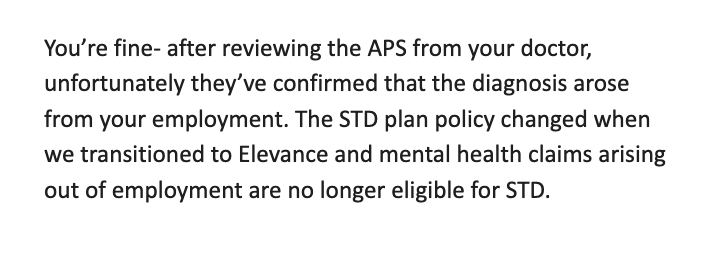
- Violation of the ADA: By failing to engage in the Interactive Process and refusing to provide reasonable accommodations, they violated the Americans with Disabilities Act. I went against my better judgement, I disclosed my illness to my boss. I was gone in two months or less. In addition, I believe they violated their fiduciary responsibility to me under ERISA because they mislead me in the coverage options as well.
- Constructive Discharge: My resignation was coerced. The company created intolerable working conditions and imposed severe financial duress, which legally equates to a termination. In the email I supposedly was quitting with, I outlined a toxic work environment, that I was not being paid and had gone broke - that I had to be 'released' (I think is the word) so I could legally now touch my retirement (which I subsequently mismanaged due to my illness).
I was put in an impossible position. Because I was dealing with a mental health crisis fueled by the very entity that employed me, I was effectively silenced. My inability to mount a formal legal challenge at the time was a direct result of the exhaustion and financial depletion they engineered. When a health insurance company makes you sick, the damage isn’t just physical. It's a long lasting betrayal of your trust.
Not to mention - there was no in-network care. Ghost Networks. My coworkers told me I was crazy - to my face - and meanwhile the company says they care about behavioral health. When I went out in crisis, I couldn't even find an in-network provider... that took care of adults. A health insurance company that makes you sick should not be allowed to deny coverage for the harm it causes.
I lamented to my boss at the time, there was no in-network care for adult psychiatric services - they were all at Children's Hospital.
Emergency Medical Treatment and Labor Act (EMTALA). Passed in 1986
I've since had this issue, look at your provider finder, they hide "emergency" care - which legally cannot be denied. It doesn't have to be covered, but it likely is. Every major insurer is lying about your emergency coverage, right now, to cut costs.
It is clear that my rights were violated, and the employer’s subsequent actions—including withholding evidence during administrative inquiries, namely my resignation notice I supposedly wrote—were designed to evade accountability. This is not merely a subjective grievance; it is a history of corporate malfeasance. This is what it looks like when a health insurance company makes you sick and then denies responsibility.
It is important to note that my own family—my mother and sister, who are otherwise vocal champions for other causes—provided no support or aid throughout this ordeal. Instead, they actively discouraged me from asserting my rights or reclaiming my dignity, urging me to remain silent and do nothing. Their inaction essentially enabled this company to act with impunity. I was left entirely alone to navigate an impossible situation, and the silence of those closest to me only deepened the harm. I lost everything. I was proud of my job, it was my identity, and it was all ripped away in a moment.
Trackbacks/Pingbacks